Surface Water Quantity About
Thursday, April 21, 2022 5:51 AMDescription
Surface water quantity refers to the amount of water held or flowing through surface water bodies such as lakes or rivers. It is a combination of flow generated directly from rainfall and snowmelt; storage and flow between the freshwater ecosystems (and any structures regulating them), along with flow emanating from surrounding aquifers and underground pathways. The three primary parameters linked to surface water quantity will be water level, discharge, and surface water area.
Why monitor surface water quantity for interventions on freshwater ecosystems?
Interventions on freshwater ecosystems such as restoration of rivers and lakes, can include a variety of modifications to the river channel, banks, obstructions, and aquatic vegetation. Read: The science and practice of river restoration, for an introduction to some of the strategies and goals in this area. As many of these intervention stem from or involve a physical manipulation of the freshwater ecosystems or its roughness – the subsequent hydrologic change in the surface water body will be reflected in changes to surface water quantity. These changes can be, for example, to annual average depth of the lake or pattern of flow regime (with shifts to months having high or low flows).
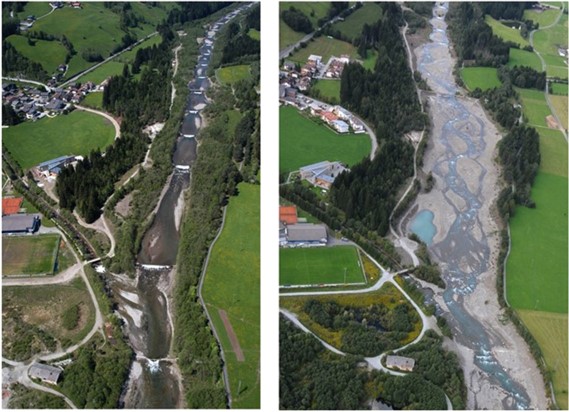
Figure 1: Example of river restoration through removal of grade-control structures along the Mareit River, Italy. View on the left is from 2005, prior to restoration. View on the right is from 2010, after restoration. Photograph courtesy of the Department of Hydraulic Engineering, Autonomous Province of Bozen-Bolzano, Italy. Source: The science and practice of river restoration. DOI: (10.1002/2014WR016874)
Does terrestrial ecosystems impact surface water quantity?
Yes, they do. Variation in surface water quantity in rivers and lakes arises partially from the interplay of two terrestrial-dependent components:
- Baseflow, which in this case is precipitation that percolates into the ground and drains slowly before reaching the channel or lake. It sustains the surface water body during periods of little or no precipitation and thus, important for water availability in dry seasons.
- Stormflow, which is the component of precipitation that reaches the channel over a short time frame through mainly overland routes. Rapid rise (high peaks or flashiness) of flow during periods of high rainfall is linked to increased flood risk and landslides.
Therefore, surface water quantity can be affected by alterations to the natural capacity of watersheds to regulate flow. For example, land cover changes can result in water flowing more rapidly off the surface of the watershed during precipitation events, rather than moving more slowly overground and through underground pathways and slowly returning to the stream.
How is surface water quantity monitored?
From the three primary parameters linked to surface water quantity, a range of tried and tested methods are available. A few primary categories are:
- Measurement of stream-stage
- Discharge by installation of wiers
- Discharge by Acoustic Doppler Current Profiler
- Surface area or water-levels by imagery or radar
Over what time scale would you typically expect to see a change?
It will be variable but do expect to have data records stretching for several years. The response will be dependent on the system’s natural variability and size of the area being monitored, as well as the pace of change. While with river restoration type interventions will have more direct and immediate changes observable, illustrating significant differences in attributes of flow due to land cover change may require decades of data collection.