Surface Water Quantity Stage
Tuesday, May 17, 2022 5:25 AMText below is based on content made available by U.S. Geological Survey (USGS)'s page on how streamflow is measured
Measure stream-stage
Most stream gauges measure stage and consist of a structure in which instruments used to measure, store, and transmit the stream-stage information are housed. Stage, sometimes called gage height, can be measured using a variety of methods. One common approach is with a stilling well in the river bank or attached to a bridge pier. Water from the river enters and leaves the stilling well through underwater pipes allowing the water surface in the stilling well to be at the same elevation as the water surface in the river. The stage is then measured inside the stilling well using a float or a pressure, or optic sensor. If done electronically, the measured stage value is stored in an electronic data recorder on a regular interval, usually every 15 minutes. Manual measurement, in comparison will at best be a few times a day.
Stage at a stream gauge must be measured with respect to a constant reference elevation, known as a datum. Sometimes stream gauge structures are damaged by floods or can settle over time. To maintain accuracy, and to ensure that stage is being measured above a constant reference elevation, the elevations of stream gauge structures, and the associated stage measurement, are routinely surveyed relative to permanent elevation benchmarks near the stream gauge.
Sampling design
- When the main monitoring objective is to quantify the change in flow regime due to the intervention, the primary location for monitoring will be immediately downstream of the intervention site and before a major junction (where this stream segment flows into or merges with another segment of stream network) as depicted in the diagram. Safe accessibility and ability to install the necessary monitoring equipment will be the other considerations when narrowing down the site.
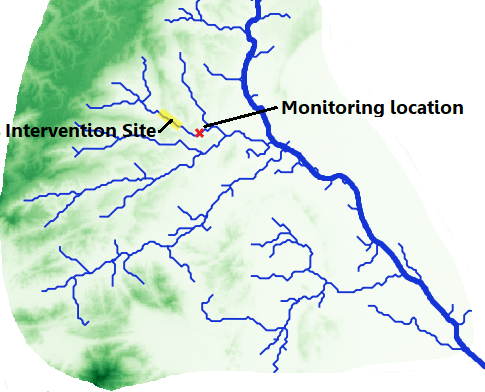
- When multiple small interventions are spread in a landscape, at least an additional monitoring site at the outlet of the sub-basin where the interventions are situated will be helpful.
- When a specific downstream beneficiary has been identified, placing a monitoring site at or before the downstream location may be necessary.
Main costs:
- The construction of a silting well or another suitable site where water level reading can be made.
- For manual measurement, cost of man-power for making the record and storing it.
- Pressure sensor with data logger could cost up to $1000 - $1500 per site
Conversion to discharge
Although stage is valuable information for some purposes, most users of stream gauge data are interested in streamflow or discharge—the amount of water flowing in the stream or river. In general, river discharge is computed by multiplying the area of water in a channel cross section by the average velocity of the water in that cross section.
The velocity of the streamflow can be measured using a current meter. Thus, to obtain discharge:
- The stream channel cross section is divided into numerous vertical subsections. In each subsection, the area is obtained by measuring the width and depth of the subsection, and the water velocity is determined using a current meter.
- The discharge in each subsection is computed by multiplying the subsection area by the measured velocity. The total discharge is then computed by summing the discharge of each subsection.
Develop a rating curve
Stage-discharge relations are developed for stream gauges by physically measuring the flow of the river at a wide range of stages; for each measurement of discharge there is a corresponding measurement of stage. To develop a rating curve, ideally discharge measurements should be taken at the stream gauges every 6 to 8 weeks, ensuring that the range of stage and flows at the stream gauge are measured regularly. Special effort should be made to measure extremely high and low stages and flows because these measurements occur less frequently. The stage-discharge relation depends upon the shape, size, slope, and roughness of the channel at the stream gauge and is different for every stream gauge. When the stage-discharge relationship in from of a rating curve is established, the stream-stage can be used to estimate discharge quickly.
Main Costs:
- Current meter for measurement of velocity. The cost will vary depending of the range of measurement required and accuracy, but will be upwards of $500.
- Cost of measure discharge at regular intervals (while ensuring safety of staff) sufficient number of times to develop the rating curve.