Water Quality Pathway of Change
Wednesday, May 18, 2022 5:44 AMThe pathway of change for water quality involves multiple strategies depending on the quality feature(s) one is interested in. Most concerns with respect to water quality are related to elevated concentrations of sediments, nutrients (particularly nitrogen (N) and phosphorus (P)), pesticides and heavy metals. In these cases, the most important strategy involves controlling inputs of excess sediments, nutrients, pesticides, and heavy metals from uplands to streams and rivers.
For sediments, please refer to the chapter on soil erosion to learn about the pathway of change to control excess sediment from entering streams and rivers.
For nutrients, please refer to the chapter on nutrient loading to learn about the pathway of change to control excess nutrients (N and P) from entering streams and rivers.
For pesticides, the main strategy involves decreasing amount of pesticide used. Additional key strategies when pesticides are already in the terrestrial systems include reducing risk of pesticide transport to surface or groundwater and reducing the persistence or mobility of the active ingredients. These are beyond the scope of this chapter, so won’t be elaborated further. Please, refer to this webpage for a deep overview on pesticides and water pollution and here for learning about analytical methods.
For heavy metals, again, the main strategy involves decreasing the amount that is released into terrestrial systems (e.g., from mining) and directly into the streams and rivers (e.g., from industrial processes). Given the complexity of heavy metal transport, processing and fate, this topic is not covered in this chapter. This paper provides more information on heavy metal contamination in rivers across the globe.
In addition to controlling inputs of excess material, in-stream strategies can be used as a complement to decrease the amount of sediment and nutrients transported to downstream systems. These in-stream strategies include:
- ***Regenerative Stormwater Conveyance (RSC)***: a stormwater management tool that uses a series of step-pools and subsurface geomedia to detain and treat stormwater. Experimental RSC systems show promise in restoring pre-development hydrographs and attenuating some suspended solids, N and P. However, as these structures often fail to provide expected results, they do not optimize contaminant removal.
- Bank stabilization structures: bio-engineered products such as coconut fiber rolls, and streambank re-grading are all used to minimize further erosion of stream banks. Rootwads and boulder revetments are also often embedded in the bank in an attempt to minimize channel migration. Bank stabilization projects are fairly successful in rural and agricultural areas; but their success rate is often lower in urban areas where they often cannot withstand storm flows, and where high flows and scarcity of transportable sediment create high erosive potential.
- Channel reconfiguration and grade control: these practices are used to repair heavily incised channels, to improve water conveyance in flood-prone areas, and to improve streambed and bank stability, hence decreasing downstream sediment load. Often, in-channel structures are used in an attempt to alter the thalweg of the stream to shunt flow in a desired direction using rock vortex weirs and cross veins.
- Creation of pools and instream habitat restoration: these practices are often used to enhance nitrogen processing with the objective to reduce nitrate transported to downstream systems. Denitrification, the transformation of nitrate into N gases, is the desirable process to be promoted as it will result in the complete removal of N molecules from the aquatic system. While pools are created to allow water to be stagnated, thus creating the anaerobic condition required for denitrification to occur, instream habitat restoration aims at improving the amount organic matter that is often lacking in agricultural and rural streams and is essential for denitrification to occur as well.
From a biodiversity standpoint, temperature is an additional relevant water quality feature.
The effectiveness of these strategies in reducing sediment and nutrient inputs into streams, as well as their transport to downstream systems is highly variable across different landscapes. Effects depend greatly on hydrologic, pedologic, geomorphic and geologic contexts as well as on the amount, timing, and location of excess sediments and nutrients reaching the in-stream structures.
The figure below summarizes the pathway of change for in-stream water quality, with an emphasis on sediment and nutrient concentrations while highlighting parameters to be monitored to assess effects on water quality from implementing in-stream restoration strategies. At the plot scale, if the strategies listed in the pathway of change page are implemented, there is the potential to reduce stream bank erosion, increase streambed stability, reduce stream bank P concentrations, and increase denitrification in artificial pools and floodplains, respectively. Reductions of stream bank and bed erosion, in turn, is expected to contribute to reduced amounts of sediments being transported downstream. Reduced stream bank P concentrations contributes to decreased P load. Finally, increased denitrification is expected to contribute to reducing N loads to downstream systems.
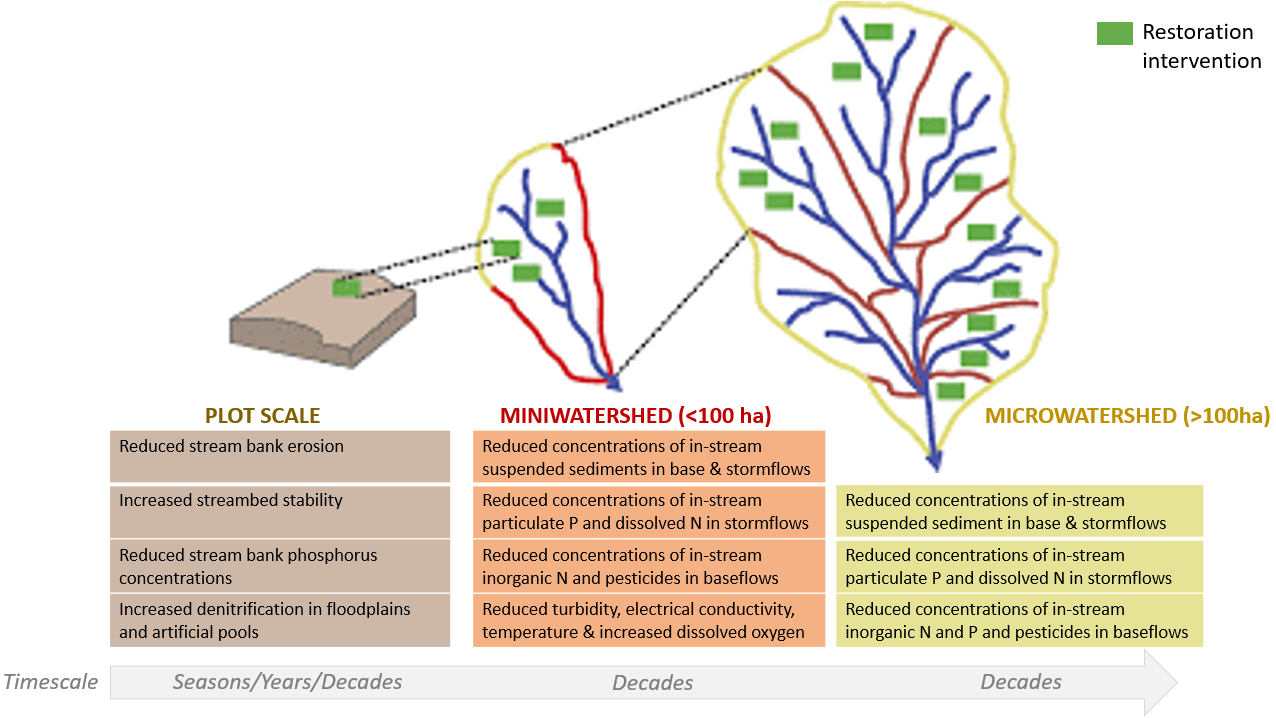
Figure 1 Pathway of change related to in-stream water quality, with an emphasis on sediment and nutrient concentrations